A 100 Ah lithium battery and a 100 Ah tubular battery do not provide the same usable backup, recharge time or ownership cost. You will be able to calculate realistic runtime, check whether your inverter is compatible, and compare the two options on installation, maintenance and replacement effort.
Key takeaways
- Compare usable watt-hours, not only the battery’s ampere-hour rating.
- Add appliance wattage to estimate runtime from actual household loads.
- Confirm inverter voltage, charging profile and battery communication compatibility.
- Include maintenance, recharge time and replacement costs in your decision.
What you are actually comparing: lithium chemistry, usable energy and daily upkeep
A fair V Guard lithium battery vs tubular battery comparison starts with usable watt-hours, not the printed ampere-hour figure. A 12 V, 150 Ah battery stores 1.8 kWh nominally, but inverter losses, permitted depth of discharge, voltage cut-off and ageing reduce what reaches your appliances.
A 100 Ah lithium battery and a 100 Ah tubular battery therefore do not guarantee equal runtime.
| Option | What changes in home backup | Practical consequence |
|---|---|---|
| LiFePO4 lithium | Higher usable capacity, lower self-discharge, faster charging and no routine water topping | More usable energy in a smaller, lighter enclosure; the BMS limits current and protects against overcharge, over-discharge and temperature faults |
| Tubular lead-acid | Peukert effect reduces available capacity as discharge current rises; bulk, absorption and float charging are standard | A high-power load gives less energy than the 20-hour Ah rating suggests; add ventilation, inspect terminals and top up distilled water |
| Either chemistry | Sustained heat accelerates ageing; lithium charging below 0°C can trigger BMS protection | Install away from heat and confirm the operating-temperature and charging limits |
The tubular battery vs lithium battery decision also includes replacement effort. Lithium usually avoids watering, acid spills and frequent terminal cleaning, while tubular units are heavier and occupy more floor space. Lithium is not automatically better for motor starting: verify the inverter’s surge demand against the battery’s BMS discharge limit.
A lithium battery also needs a compatible charging profile; do not apply unsuitable lead-acid equalisation voltage.
Calculate runtime from your appliances, not from the inverter’s VA label
Runtime comes from watts drawn, not the inverter’s VA rating. Add the running wattage of every appliance you will use, then calculate usable battery energy:
Usable watt-hours = battery voltage × amp-hours × usable depth of discharge × inverter efficiency
A 12.8 V, 100 Ah battery stores 1,280 nominal watt-hours. At 90% usable discharge and 85% inverter efficiency, about 979 Wh reaches the appliances. A 300 W load therefore runs for roughly 3.3 hours before allowing for ageing, inverter idle consumption or startup surges.
- Read appliance watts from the nameplate; for fans, refrigerators and pumps, allow for motor-starting demand.
- Divide usable watt-hours by total running watts. A 500 W load uses energy 1.67 times faster than a 300 W load.
- Apply the battery’s discharge limit, not the full amp-hour label. A tubular battery rated at a 20-hour discharge rate loses available capacity as current rises because of the Peukert effect.
- Check the inverter and battery limits. A 1 kW load on a 12 V system draws about 83 A before conversion losses, so cable, fuse, terminal and BMS ratings matter.
This is why tubular battery vs lithium battery comparisons based only on “100 Ah” mislead. A lithium battery for inverter backup usually supplies a larger share of its rated energy at higher discharge rates, but its BMS and the inverter still set the maximum load.
Check inverter compatibility before replacing a tubular battery
A 12.8 V lithium battery is not automatically compatible with a 12 V inverter that previously used a tubular battery. Confirm the inverter supports lithium charging before you connect it; an unsuitable lead-acid profile can overcharge the pack, trigger the BMS, or keep the battery from reaching full capacity.
1. Check for a selectable lithium or LiFePO4 mode. If the inverter only offers bulk, absorption and continuous float settings for lead-acid batteries, ask the manufacturer whether those voltages are safe for the specific battery.
2. Match the inverter’s charge-voltage range to the battery’s data sheet. Disable equalisation charging unless the battery manufacturer explicitly permits it; equalisation voltage intended for tubular batteries can damage lithium cells.
3. Compare the inverter’s maximum charging current with the battery’s permitted charge current and BMS limit. A charger that supplies too much current can disconnect the battery during charging.
4. Verify the low-voltage cut-off and recovery voltage. The inverter must stop before the battery reaches its specified minimum voltage, then restart cleanly after the battery recovers or the grid returns.
5. Check communication requirements. Some lithium batteries need CAN or RS485 communication between the BMS and inverter; without it, protection settings or state-of-charge readings may fail.
6. Inspect the 12 V cables, fuse or breaker, terminals and surge rating. A 1 kW load can draw more than 83 A from a 12 V system before conversion losses.
Buy a lithium battery for inverter use only after these figures match. A V-Guard lithium battery still needs a compatible inverter, charger and protection system; its plug terminals alone do not prove compatibility.
Compare recharge time, maintenance and total ownership cost
Lithium’s premium purchase price is justified when outages cycle the battery frequently, faster recharge restores service before the next outage, and avoiding water checks and acid cleanup has value. For occasional, short outages, a tubular battery usually wins on upfront cost.
| Factor | Lithium battery | Tubular lead-acid battery |
|---|---|---|
| Purchase | Higher initial price; compare usable watt-hours, not nominal ampere-hours. | Lower initial price, but the same Ah rating does not guarantee the same runtime. |
| Recharge | Accepts higher current through more of the cycle, so recovery is usually faster. The charger rating, grid supply, BMS limit and state of charge still set the actual time. | Charging slows during absorption, extending recovery after a deep discharge. |
| Routine upkeep | No electrolyte top-up, acid mist or normal-operation leakage; protection settings and BMS health still matter. | Requires ventilation, electrolyte inspection, distilled-water top-up and terminal cleaning. |
| Ownership | Lower routine labour and energy loss can offset the premium during frequent cycling; include eventual replacement and disposal. | Lower entry cost suits infrequent use, but water, service, losses and replacement intervals affect the final bill. |
Treat “V Guard battery price” as incomplete unless the quotation states chemistry, usable energy or permitted depth of discharge, warranty, BMS, charger compatibility, installation and taxes. A 100 Ah lithium battery and 100 Ah tubular battery are not equal purchases if their usable watt-hours differ.
Ask Soumya Enterprises to show recharge-time assumptions and every replacement cost in writing. In the V-Guard lithium battery vs tubular battery decision, choose lithium when saved downtime and reduced upkeep outweigh that documented premium.
Related products
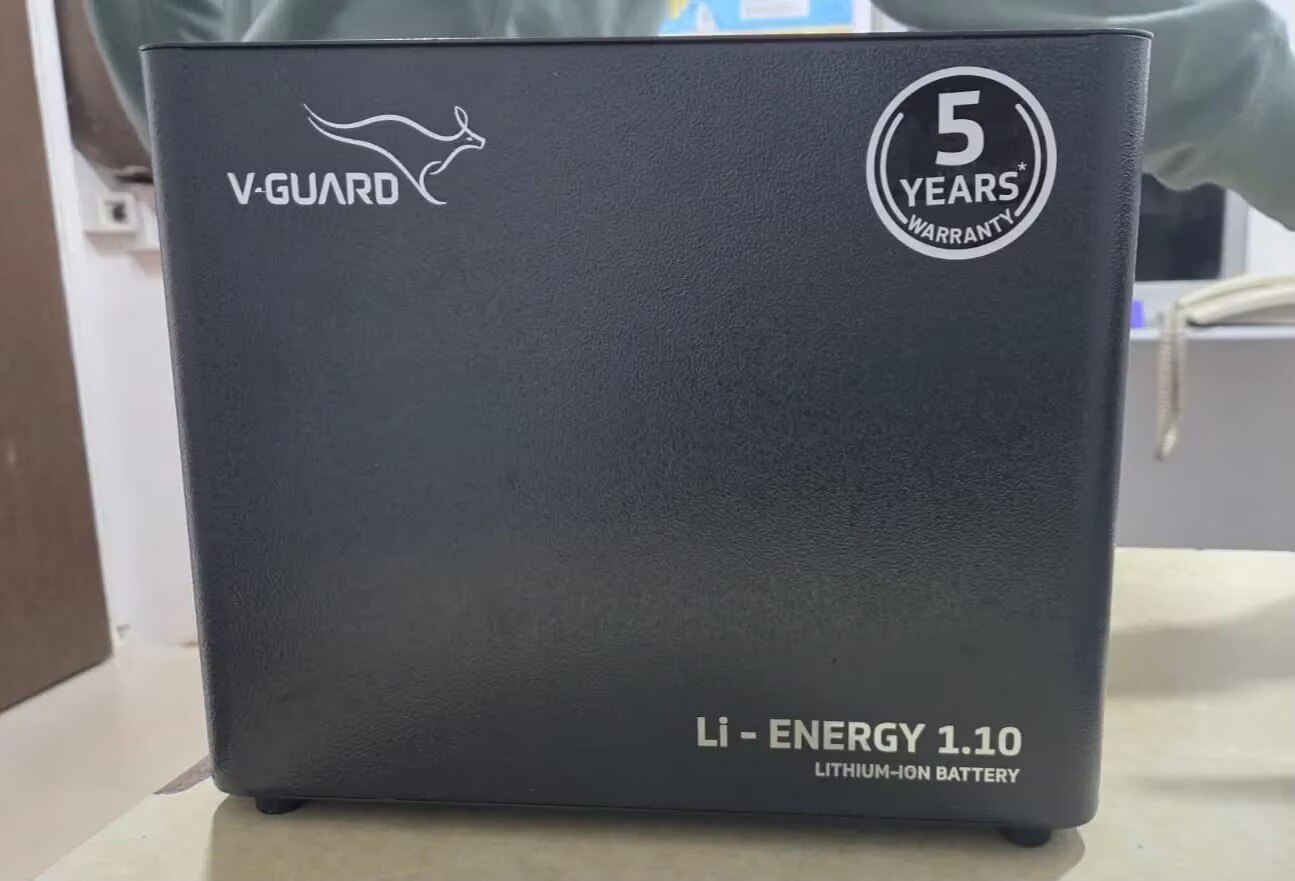
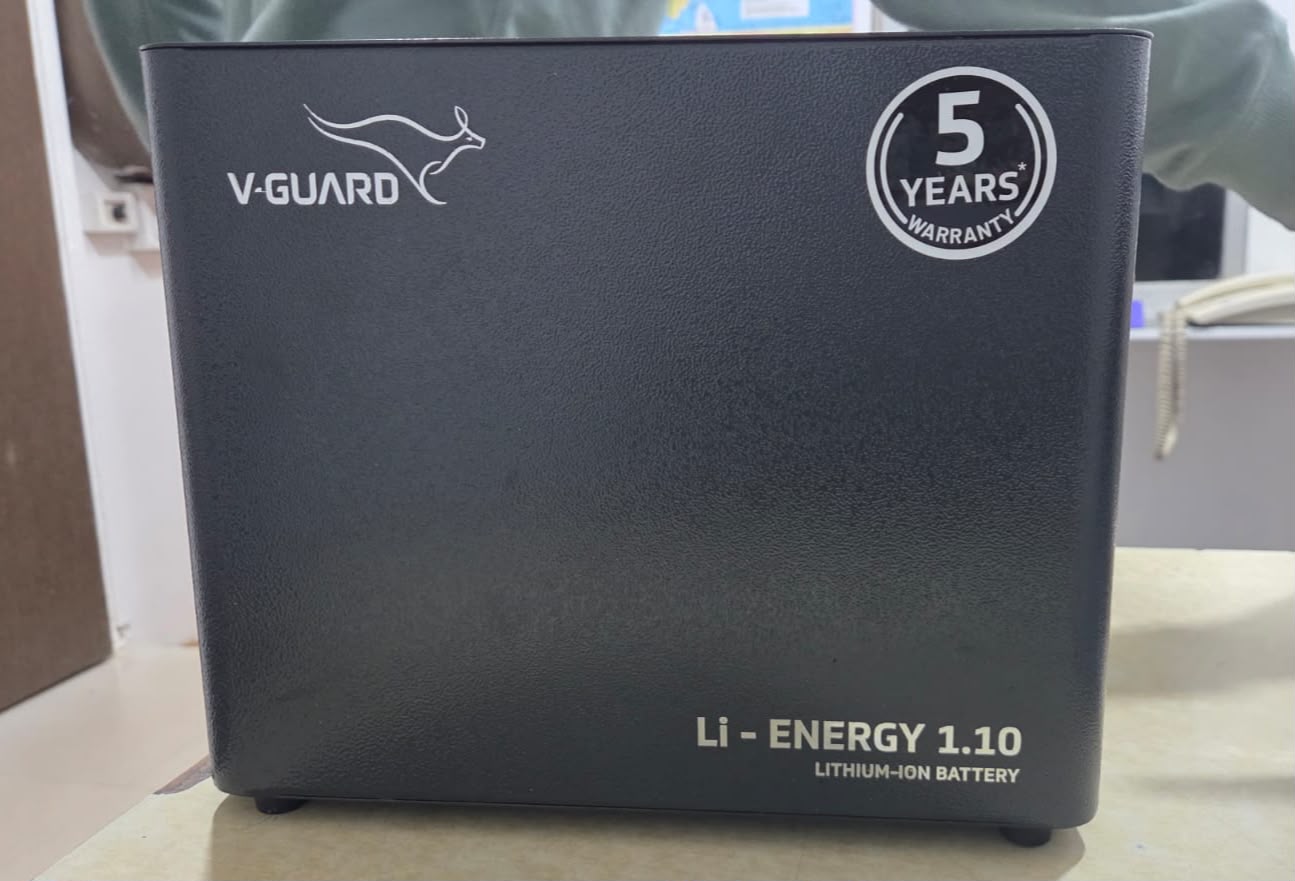 | V Guard Lithium Battery Model name Li-ENERGY 1.10 Nominal Voltage 12.8 V Rated Capacity 100 Ah Operating Voltage 10.5 V - 14.2 V Cell Chemistry LiFePo4 Standard Charging... View product → |
 | Inverter Microtek’s lithium inverters—particularly their next-generation setups like the i-Lithium WiFi 1500SW and lithium-compatible smart series—represent a... View product → |
Use a buying checklist to choose the safer, better-supported system
Choose the system that matches your load, inverter and willingness to maintain it—not the lowest sticker price. A standalone V-Guard lithium battery suits a compatible existing inverter; an integrated lithium inverter reduces compatibility guesswork; a tubular system suits homes prioritising lower initial cost and accepting water checks, ventilation and heavier replacement work.
| Option | Choose it when | Main check |
|---|---|---|
| Standalone V-Guard lithium battery | You already own a sound inverter | Confirm lithium mode, charge-voltage range, maximum charging current, low-voltage cut-off, restart behaviour and BMS communication |
| Integrated lithium inverter | You want one matched, compact system | Confirm usable watt-hours, warranty, service coverage and replacement terms |
| Tubular battery | Your inverter supports lead-acid charging and budget matters most | Provide ventilation, electrolyte inspection, corrosion control and safe acid handling |
Before accepting a quote, use this checklist:
- Ask for chemistry, nominal voltage, ampere-hours, usable energy, permitted depth of discharge, BMS inclusion, warranty exclusions, installation charges and taxes. “V-Guard battery price” means little without these figures.
- Compare usable watt-hours, not nominal Ah. A 100 Ah lithium battery and a 100 Ah tubular battery do not provide identical runtime.
- For a standalone V-Guard lithium battery, obtain written confirmation that the charger will not apply unsuitable equalisation or continuous float settings.
- Size cables, fuses, terminals and surge capacity for the load. A 1 kW load on 12 V draws about 83 A before losses.
- Choose tubular battery vs lithium battery based on your actual routine: frequent outages favour lower-maintenance lithium; occasional outages and an existing compatible inverter can favour tubular.
Frequently asked questions
How do you compare a V Guard lithium battery with a tubular battery fairly?
Compare usable watt-hours after inverter losses, depth-of-discharge limits, voltage cut-offs and battery ageing—not just the printed ampere-hour figure.
How do you calculate home backup runtime?
Add the running wattage of the appliances you need, then divide usable battery watt-hours by that load and allow for inverter losses.
Can you replace a tubular battery with a lithium battery for an inverter?
Only after checking the inverter’s battery voltage, charging profile, low-voltage cut-off, maximum charging current and lithium communication requirements.
What should you include when comparing lithium and tubular battery costs?
Compare purchase price, installation, electricity used during recharging, maintenance, expected service life and future replacement costs.
Related product
 | Inverter The Genus MaxiLion 2400 (2400VA / 2.4KVA) is a premium, next-generation power backup solution. View product → |
Keywords